You can bait a roof cavity every month of the year. If the yard is feeding a population, you are not solving a problem — you are running a permanent cull on a supply that keeps replacing itself.
Start with the range
- 1A house mouse rarely ranges more than a few metres from food and shelter. If you have mice, the source is essentially on top of you.
- 2A brown rat forages roughly 25 to 50 metres from its harbourage — comfortably next door.
- 3Spilled poultry feed is the single most reliable rat attractant in suburban Melbourne.
- 4Rats need daily water. Removing it is often easier than removing food, and just as effective.
Foraging range changes what you should look at
Before auditing anything, work out how far the animal could have come. It narrows the search enormously and it tells you whether the problem is yours alone.
House mice live remarkably locally. Their home range is typically only a few metres across, which means a mouse population is being sustained by something extremely close — a pantry, a pet food container, a shed, a compost bin against the wall. You do not need to audit the whole block. You need to audit the nearest ten metres, thoroughly.
Rats are different. Brown rats commonly forage 25 to 50 metres from where they shelter, and black rats can range further still. At that radius, a pristine yard is no protection if the property behind you has an unsecured compost heap or a poorly kept chicken run. This is why rat problems so often feel unfair — and why exclusion from the building matters more than yard hygiene alone when the attractant is not on your land.
How far each species will travel to feed
Typical foraging radius from harbourage. The scale is what determines whether the source is on your property.
The attractant audit
| Source | Risk | What to actually do |
|---|---|---|
| Poultry feed | Highest | Store feed in sealed metal bins, never bags. Use treadle feeders, remove feed overnight, and mesh the coop floor and an apron around the perimeter |
| Open compost | Very high | Switch to an enclosed tumbler or mesh the base. No meat, dairy or cooked food. Turn it regularly — undisturbed heaps become nests |
| Fallen fruit | High | Collect daily in season. Net trees where practical. Windfall under a citrus tree feeds a colony indefinitely |
| Bins | High | Lids fully closed, no cracks in the body, bins off the ground and away from fences. Rinse periodically — residue on the outside is enough |
| Pet food and bowls | High | Feed indoors, or bring bowls in at dusk. Store dry food in sealed containers, not in the bag in the shed |
| Standing water | Moderate | Fix dripping taps, empty pot saucers, cover water features. Often the easiest attractant to remove entirely |
| Bird feeders and aviaries | Moderate | Use catch trays, sweep spill daily, and store seed in metal containers |
| Woodpiles and stored materials | Moderate | Harbourage rather than food. Raise 300 mm off the ground and keep clear of fences and walls |
| Dense ivy and groundcover | Moderate | Ivy on a wall is a ladder and a nest site together. Keep it off the building entirely |
| BBQ and grease trays | Low–moderate | Empty and clean after use. Easy to forget, and genuinely attractive |
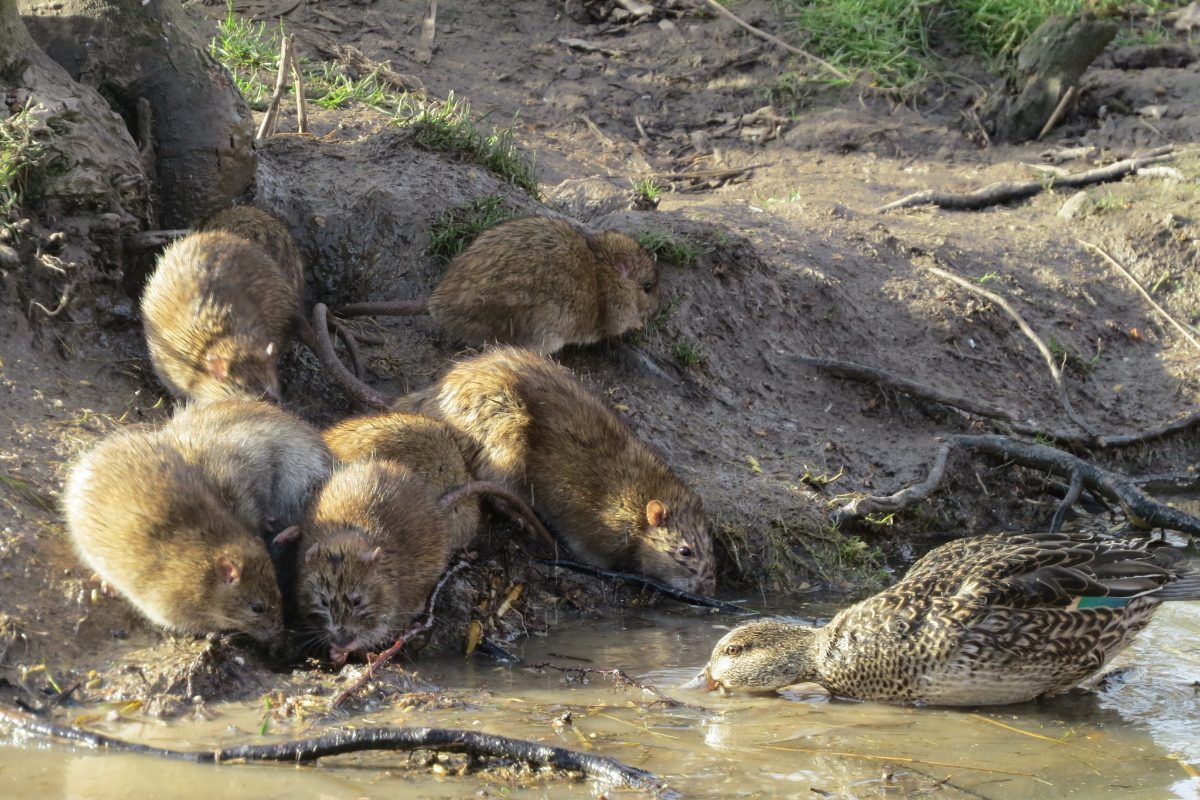
Chicken coops deserve their own section
If you keep poultry and you have rats, the coop is almost certainly the reason. This is not an argument against keeping chickens — it is an argument for setting the run up properly, because a badly managed coop will sustain a rat population indefinitely no matter what you do indoors.
Feed is the whole problem
Scattered grain on the ground is a continuous open buffet. Treadle feeders that only open under a bird’s weight remove most of it, and taking feeders in overnight removes the rest.
Store feed in metal
Rats chew through plastic bins and bags without difficulty. Sealed metal containers with a firm lid are the only reliable storage.
Mesh the floor and an apron
Brown rats burrow in. Heavy galvanised mesh under the coop plus an apron extending outward from the perimeter stops tunnelling underneath.
Collect eggs daily
Rats will take eggs and occasionally chicks. Daily collection removes both the food and the incentive to keep returning.
Rodenticide near a chicken run is a genuine hazard — to the birds directly, and to anything that eats a poisoned rat. If you keep poultry, favour trapping and exclusion, and use only enclosed tamper-resistant stations placed where birds and pets cannot reach them.
When your yard is clean and the problem persists
This is the common and frustrating case. You have secured the bins, enclosed the compost, cleared the fruit and fixed the taps — and you are still hearing something in the roof.
At a 25 to 50 metre foraging radius, the sustaining attractant may simply not be on your property. You cannot audit a neighbour’s yard, and asking rarely goes well. What you can control is whether your building is enterable.
That shifts the strategy: yard hygiene reduces local pressure, but physical exclusion is what actually protects the house when the food source belongs to someone else. Sealing entry points, trimming the branch and fence routes that deliver animals onto the roof, and removing harbourage against the walls all keep working regardless of what is happening two doors down. Households across Melbourne’s south-east typically pair a yard audit with rodent control in Rowville and nearby suburbs for this reason — the audit handles what you own, and the exclusion handles what you do not.
Remove water first, because it is usually the quickest win and rats need it daily. Then secure food, starting with poultry feed and compost. Then remove harbourage against the building. Then exclude — seal entry points and cut the access routes. Baiting or trapping comes last, and only once the support system has been dismantled, or you are simply culling into a vacancy.
Frequently asked questions
Will cleaning up the yard alone get rid of them?
It reduces the population a property can support, sometimes dramatically. But if animals are already nesting in your roof, or the sustaining attractant is on a neighbouring property, yard work alone will not clear them. Combine it with exclusion.
Does compost always attract rats?
No — badly managed compost does. Enclosed tumblers, a meshed base, no meat or dairy, and regular turning make a heap far less attractive. An open, undisturbed pile with food scraps is close to ideal rat habitat.
Should I stop keeping chickens?
Not necessarily. The issue is almost always feed management rather than the birds. Treadle feeders, metal feed storage, overnight removal of feed, a meshed floor with a perimeter apron and daily egg collection address most of it.
My neighbour’s yard is the problem. What can I do?
Focus on what you control — exclusion from your building, harbourage against your walls, and access routes over fences and branches. A polite conversation sometimes helps. Where there is a genuine health nuisance, councils in Victoria do have public health powers, though that is a last resort rather than a first step.
Do I need to remove the woodpile entirely?
Usually not. Raise it about 300 mm off the ground, keep it away from fences and walls, and disturb it occasionally. Rodents want undisturbed, ground-contact harbourage; a raised, accessible stack is far less attractive.
How long before yard changes make a difference?
Pressure usually eases within a few weeks as animals redistribute toward better food elsewhere. Established indoor populations do not leave on their own though — those still need removal, and the building still needs sealing.
- Home range and foraging distance for Mus musculus, Rattus norvegicus and Rattus rattus; figures are typical ranges and vary with food density.
- Daily food and water requirements of commensal rodents.
- Rodent harbourage preferences and exclusion practice around poultry housing.
- Secondary poisoning risk associated with rodenticide use near poultry, pets and wildlife.